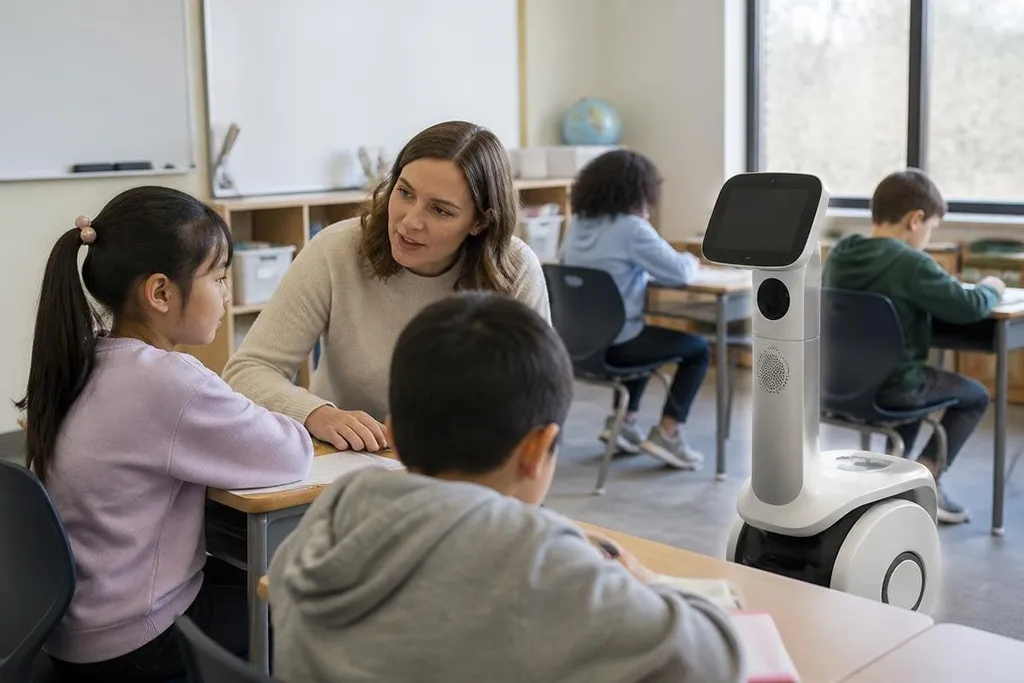
A classroom robot can repeat a lesson, guide a practice task, or give a student another chance. It can't read a child’s silence, settle a dispute, or decide when a lesson needs to change. The useful question is where its narrow skills fit into a teacher’s day.
- Robots can repeat practice without tiring.
- Teachers still make decisions about people, context, and care.
- Schools need clear limits before buying classroom hardware.
What an educational robot can do
Educational robots work best when the task has clear rules and a visible result.
Students can program a small mobile robot to move through a marked route. A robot arm can show how joints, motors, and sensors work. A speaking system can run the same vocabulary drill many times.
Repetition matters because students don't all need the same number of attempts. The system can give another instruction, wait for an answer, and repeat a problem without showing frustration. That gives a teacher more time to watch the room and help the student who is stuck for a different reason.
The robot also gives students something they can see and touch. Its sensor detects an object, its motor moves, and its program produces a result. Those links make abstract lessons easier to test, though the teacher still needs to explain why the result happened.
Where the teacher remains necessary
Teaching includes much more than sending information. A teacher sets the pace, spots confusion, handles conflict, and changes the plan when the class needs a different explanation. Those actions depend on context that a robot may not have.
A student who stops working might need a simpler example, a short break, or help with a problem outside the lesson. A robot can respond to a programmed signal, such as a wrong answer or a long pause. It can't reliably decide which human reason sits behind that signal.
Safety adds another limit. A school needs rules for moving hardware, cables, batteries, cameras, microphones, and student data. A robot that records speech or images needs a clear reason to do so, along with a plan for storage and deletion.
A classroom demo can show a robot answering questions, but it can't prove that the system helps a teacher manage a full school day. Robot24.com's education robotics reporting can add the model, test setting, date, and task behind each claim. That record gives a school a basis for judging the robot's role in class and the teacher's remaining control. The next question is what that human role costs when a school buys the system.
The cost of handing over the lesson
It may reduce repeated work, but it also adds work around the lesson. Staff need time to set up the robot, charge it, update its software, fix errors, and teach students how to use it safely. If that work takes longer than the task it replaces, the purchase has missed its purpose.
The lesson can also become too narrow. Its behavior follows its sensors, software, and instructions. Students may learn to get the expected response instead of asking why the system failed or how its design affects other people.
Access matters too. One robot shared by a large class may give each student only a few minutes of practice. A school should measure hands-on time, staff time, and repair time before it compares the robot with a worksheet, a simulation, or a human assistant.
I'd keep educational robots in a supporting role until a school has measured those costs over a full term.
A practical buying checklist
Use these checks before approving a classroom robot:
- Name the task: write down the lesson activity the robot will handle and the result students should produce.
- Count practice time: record how many minutes each student gets with the robot during one class.
- Set the safety rules: cover moving parts, trip hazards, charging, cameras, microphones, and data storage.
- Plan the human handoff: decide when the teacher takes over and what signs trigger that change.
- Measure staff work: include setup, charging, software updates, repairs, and training in the school’s time estimate.
- Set a review date: compare learning results and teacher workload after a defined trial period.
That process leaves room for robots to handle repeatable practice while teachers handle judgment, care, and changes in the room. The open question is not whether a robot can teach; it is how much classroom time it can take before the work of running it costs more than the lesson it supports.